

Google’s new AI-powered search, often called Search Generative Experience (SGE), is changing the way people find information online. Instead of just showing a list of links, search engines now generate answers directly using AI. This shift has introduced a new priority: AI Search Optimization—the practice of structuring your content so it appears within these AI-generated results.
What used to be prime real estate at the top of Google’s search results—mainly reserved for paid ads—is now accessible to any business for free. How? By creating content that directly answers common questions. Google’s AI-driven search prioritizes clear, specific answers, pulling from well-structured FAQs, how-to guides, blogs, and other informative content.
If your website provides concise, authoritative responses, you have a better chance of being featured in AI-generated results—without paying for ads.
For businesses that used to rely on sponsored links, traditional SEO strategies need to evolve. If your website isn’t optimized for AI-generated results, you could see less traffic and lower visibility.
Let’s break it down—and, more importantly, figure out what you can do to stay ahead.
Table of Contents
What Is AI-Powered Search (SGE)?
Google’s Search Generative Experience (SGE) is an AI-enhanced search feature that provides instant, AI-generated answers at the top of search results. Instead of just showing ranked websites, Google summarizes information from multiple sources and presents it conversationally.
For example, if you search “best websites for small businesses,” Google’s AI might:
- Provide a direct AI-generated recommendation instead of just links.
- Pull information from multiple websites and summarize it.
- Show a “Learn More” section with related articles.
Why This Matters for SEO
- Users may not click on links as much since they get instant answers.
- AI-generated results prioritize expert, well-structured content over traditional keyword-stuffed pages.
- Businesses need to optimize for AI visibility rather than just traditional search rankings.
What Does This Mean for Your Website?
As Google shifts toward delivering AI-generated answers, your website needs more than just high rankings—it needs to show up inside those answers. That’s where a new approach comes in. If traditional SEO focuses on climbing the ranks, this next evolution focuses on helping AI use your content directly. It’s called Generative Engine Optimization (GEO)—and it’s quickly becoming essential for effective AI Search Optimization.
SEO vs. GEO

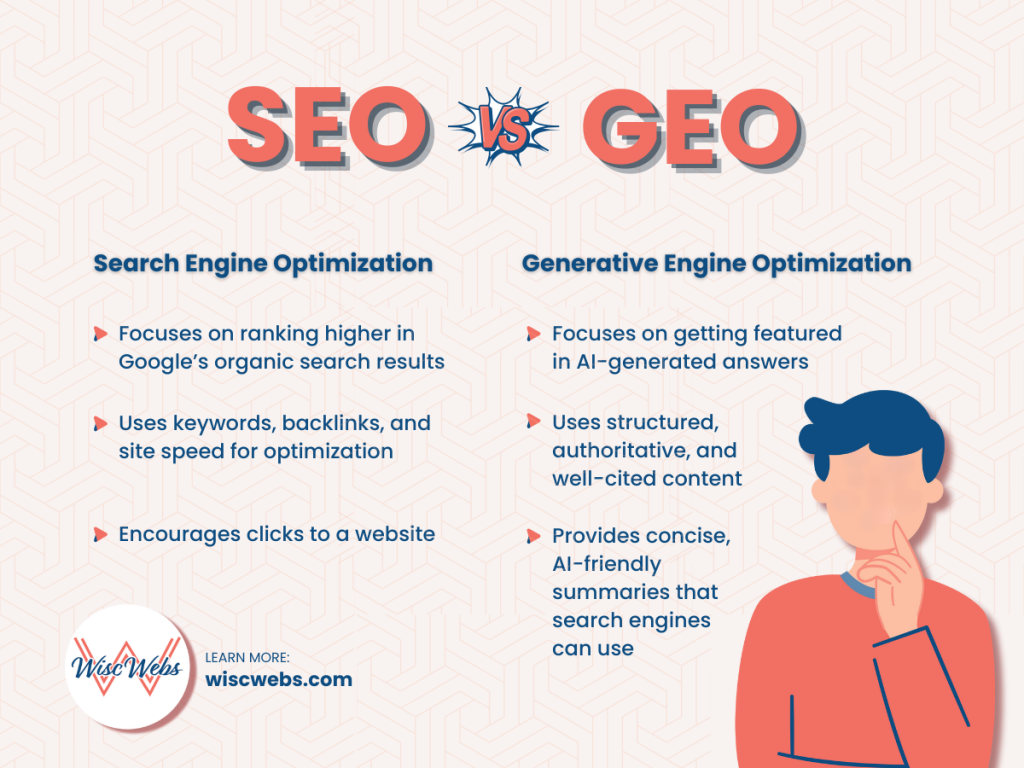 (How GEO Differs from Traditional SEO)
How to Optimize Your Website for AI Search (GEO Strategy)
Want to make sure your content still gets seen in an AI-driven search world? Here’s what to do:
1. Write Clear, Authoritative Content
- Use FAQ-style sections with direct answers (these are AI gold).
- Skip the fluff—keep your writing concise but complete.
- Anticipate what users are asking, and answer it clearly.
2. Use Structured Data (Schema Markup)
Structured data helps search engines understand your content beyond just keywords. By labeling specific elements—like articles, products, reviews, and FAQs—you provide the context AI needs to recognize and surface your content in search results.
For example, if you add FAQ schema to your content, Google may pull your answers directly into its AI-generated summaries, giving your business greater visibility without paid placement.
Want to make your content more AI-friendly? Here’s how to put schema markup to work:
- Firstly, identify high-value pages like FAQs, how-to guides, product listings, and informative articles.
- Secondly, apply structured data using tools like Google’s Structured Data Markup Helper or plugins such as Yoast SEO (for WordPress).
- Thirdly, choose the right schema types, including:
- FAQ Schema (for Q&A-style content).
- How-To Schema (for step-by-step guides).
- Article Schema (for blog posts and news).
- Product Schema (for e-commerce pages).
- Local Business Schema (for your business’s hours, contact details, and location).
- Lastly, test your markup using Google’s Rich Results Test to ensure it’s working properly.
As a result, by integrating structured data, you make it easier for AI-powered search engines to process your content—ultimately increasing your chances of being featured in AI-generated answers.
3. Focus on E-E-A-T (Experience, Expertise, Authority, Trustworthiness)
E-E-A-T stands for Experience, Expertise, Authority, and Trustworthiness. It’s a quality standard Google uses to evaluate content, particularly for topics that impact people’s lives (like health, finance, and business decisions).
In an AI-driven search landscape, Google prioritizes content that demonstrates strong E-E-A-T. If your website lacks credibility signals—like author bios, citations, and original insights—you may struggle to appear in AI-generated search results. Therefore, businesses that establish themselves as trusted industry voices are more likely to rank higher and be featured in AI summaries.
Want to build more trust and authority into your content? Here’s how to put E-E-A-T into action:
- AI looks for credible sources—so establish your brand as an authority.
- Feature author bios with credentials.
- Link to trusted sources in your content.
4. Create AI-Friendly Summaries & Snippets
- Include summary sections at the start of articles.
- Use bullet points and lists (easier for AI to scan and summarize).
- Add structured Q&A sections—Google’s AI often pulls these directly.
5. Monitor & Adapt Your SEO Strategy
- Keep an eye on Google Search Console for AI-driven traffic patterns.
- Additionally, regularly update old content to stay relevant to AI-generated answers.
- Furthermore, track how SGE affects your rankings and clicks over time, and adjust your AI Search Optimization strategy based on performance.
Final Thoughts
In conclusion, AI-powered search isn’t a far-off trend—it’s already changing how potential customers find answers. As Google leans into generative results, your website needs to do more than rank well. It needs to speak AI’s language.
Consequently, this is where SGE and GEO come into play. Together, they signal a shift in how businesses need to create and structure content—prioritizing clarity, trust, and usefulness over outdated tactics.
If you’re unsure where to begin, or if you’ve noticed a dip in traffic, now’s the time to adapt. WiscWebs can help align your content strategy with how search engines work today—so your business stays visible where it matters most.